

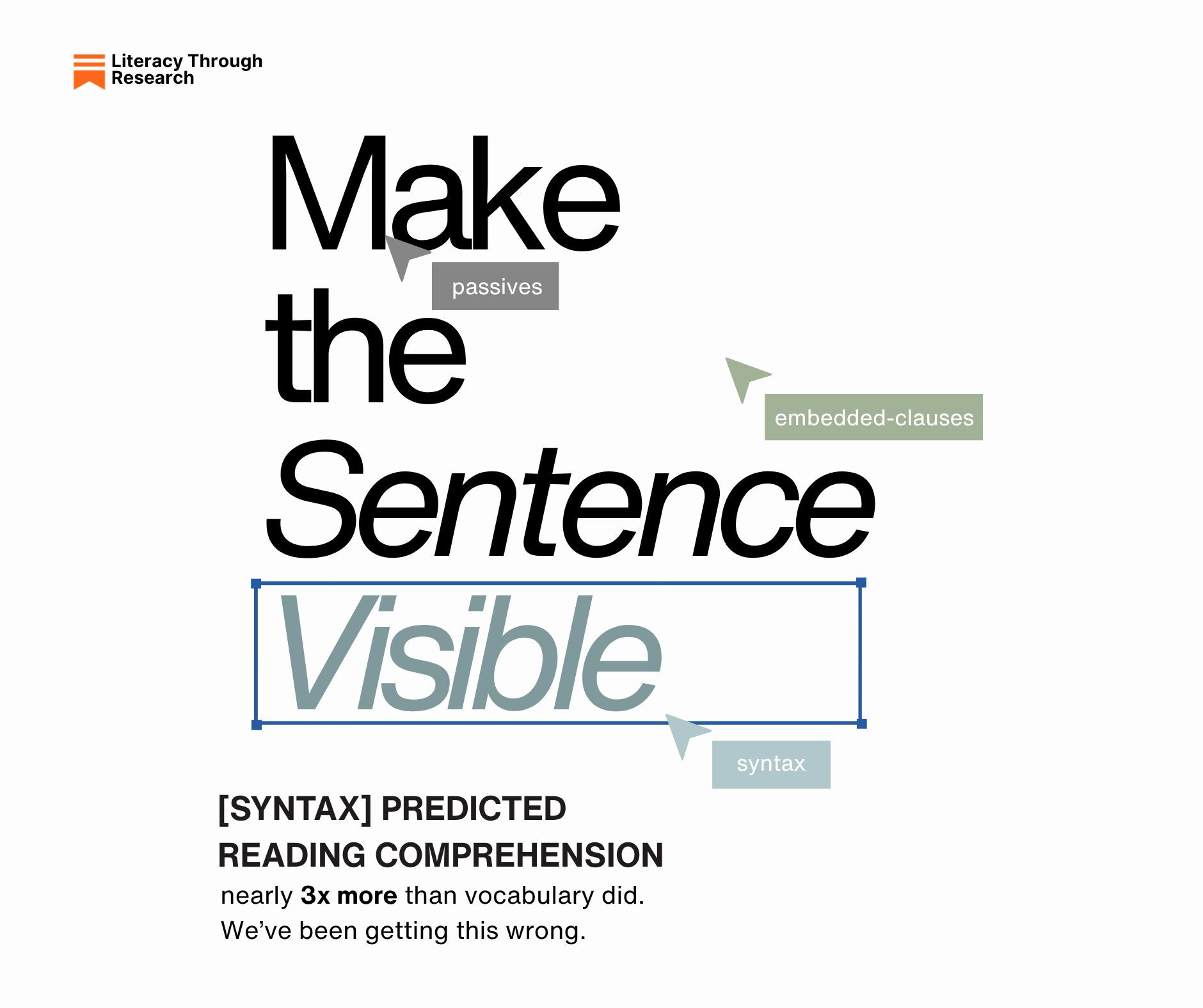
In a 2025 study published in Reading Research Quarterly, researchers tested sixth-grade students on syntactic comprehension, vocabulary, decoding, and reading comprehension. Syntactic comprehension came out as the strongest predictor of reading comprehension by a significant margin.
β = 0.63.
Vocabulary? β = 0.24.
If you’ve been told that vocabulary is the comprehension variable that matters most, that number says otherwise.
Why This Finding Is Different
The relationship between syntax and reading comprehension isn’t new territory. Researchers have been analyzing it for decades, but most of the prior work ran into the same problem: the tests used to measure syntactic skill were contaminated. Picture-selection tasks that required fluid reasoning. Sentence repetition tasks that leaked vocabulary. Grammatical judgment tasks that measured awareness, not comprehension.
Cain (2007) made this same point when she found that the relationship between syntactic awareness and reading comprehension was largely mediated by vocabulary, grammatical knowledge, and memory. That’s not a failure of the research field—it’s the field doing its job. The limitation was measurement.
Nielsen, Christensen, and Poulsen (2025) fixed the measurement problem. They built tests specifically designed to isolate syntactic comprehension using semantically reversible sentences where meaning cannot be inferred from word knowledge alone. To understand “Peter was seen by John,” you have to process the passive structure. There is no other way in. No vocabulary shortcut. No background knowledge scaffold.
By cleaning up the measurement an important finding was revealed: syntactic comprehension and vocabulary separated into distinct factors. Children who were strong on one were not automatically strong on the other. Additionally, when both were entered as predictors of reading comprehension alongside decoding…syntax won.
The implication is direct: some children are failing to understand what they read not because they don’t know the words, but because they can’t parse the sentences those words appear in.
Literacy Through Research is where research gets translated into instruction you can actually use. If you’re tired of surface tips, balanced literacy déjà vu, and PD that doesn’t stick—subscribe (free or paid!) for research-backed analysis, practical walkthroughs, and curated tools that change your structured literacy instruction.
What Syntax Actually Does in a Sentence
Before we get to instruction, we need to be precise about what syntactic comprehension is and what it isn’t.
Syntactic awareness is a metalinguistic skill. It’s the ability to reflect on and manipulate grammatical structure, catch an error, rearrange jumbled words, identify what’s wrong with “The girls climbs the tree.” Essentially, it’s a mental version of those red squiggly lines in a word document. It correlates with reading and develops with age. But as Cain demonstrated, it doesn’t appear to have a unique relationship with reading comprehension once you control for vocabulary and memory. It may matter more for word reading in context than for comprehension of connected text.
Syntactic comprehension is something else. It’s the implicit, real-time use of syntactic signals to establish meaning relations between words. Who did what to whom. What modifies what. Where the clause boundaries are. It doesn’t require a child to tell you that a sentence is wrong. It requires a child to correctly understand what a sentence means.
Tong and Deacon (2025) proposed two distinct pathways by which syntactic skills contribute to reading comprehension. The first is the syntax-to-lexicon pathway. Syntactic skill helps readers build more precise word representations and supports vocabulary acquisition. When a child can use sentence structure to infer the grammatical category and semantic role of an unfamiliar word, they are more likely to learn it and remember it accurately. This pathway matters most in early reading development, when decoding is still demanding and word-level processing is where most of the cognitive work is happening.
The second is the syntax-to-sentence pathway. This is where syntactic skill enables two specific cognitive operations: parsing and prediction. Parsing means breaking a sentence into its syntactic components and correctly identifying the relationships between them (who is the agent, who receives the action, which phrase modifies which noun). Prediction means using syntactic knowledge to anticipate upcoming words and structures, narrowing the space of what could come next before it arrives on the page.
Both pathways feed into text comprehension. But Tong and Deacon argue that the relative weight shifts with development: early readers lean on the lexicon pathway, and more proficient readers shift toward the sentence pathway. As decoding automatizes and word recognition becomes less effortful, the capacity to parse and predict becomes the binding constraint on comprehension.
By grade 6, most children are not failing because of decoding. If syntax is still accounting for 63% of the variance in reading comprehension, the sentence pathway is almost certainly doing most of the work.
Why the Texts Are Part of the Problem
There’s a third piece of this that doesn’t get enough attention: what we’re asking children to read.
Lei and Shi (2023) analyzed syntactic complexity across adapted news texts at five grade levels using 15 distinct indices such as sentence length, number of clauses, and amount of coordinate phrases per clause. The pattern was consistent: every index increased linearly from Grade 3 to Grade 12. Sentences got longer. Clauses multiplied. Noun phrases got denser and more layered.
One pattern stands out: coordination (the and/but/so structure of lower-level text) levels off around Grade 9. Subordination and phrasal complexity never do. They keep climbing straight through Grade 12. And we’re mostly not teaching them.
In other words, the syntactic features that make text hard for experienced readers are not the features we tend to address in instruction. We teach kids to use conjunctions. We do not systematically teach them to parse complex nominal phrases, navigate object-extracted relative clauses, or hold the subject of a sentence in working memory across a long intervening clause before the main verb arrives.
Tong and Deacon note that written language exposes readers to syntactic structures that are genuinely rare in spoken language. This is what they are referring to. Children who are good oral language users may still be syntactically underprepared for academic text, not because they lack language but because the syntactic register of academic writing is its own domain.
Literacy Through Research is where research gets translated into instruction you can actually use. If you’re tired of surface tips, balanced literacy déjà vu, and PD that doesn’t stick—subscribe (free or paid!) for research-backed analysis, practical walkthroughs, and curated tools that change your structured literacy instruction.
What the Research Points Toward
None of these papers offer a packaged intervention. That is one question I get asked about often: which program do I recommend for this type of instruction. The problem is, and Tong & Deacon echo this sentiment, the evidence base for syntax instruction is thin and methodologically weak as most existing studies either tested syntactic awareness rather than comprehension, or taught syntax alongside other oral language skills, making it impossible to isolate the effect.
But the research does point in a direction.
First: syntactic comprehension should be assessed as a separate construct. Not proxied through vocabulary. When measured cleanly it can be a site of individual difference and a potential target for intervention. If a child is struggling with comprehension despite adequate vocabulary and decoding, parsing may be what’s failing them.
Second: the instructional target isn’t grammar rules. It’s the real-time use of syntactic signals to establish meaning. Nielsen et al.’s whodunnit design shows us how by using semantically reversible sentences, where the only path to comprehension runs through syntax. “The spy was thanked by the secretary” and “The secretary was thanked by the spy” contain identical words. The comprehension question (who thanked?) cannot be answered without reading the structure. The spy appears first, but the passive construction tells you the secretary is the one doing the thanking. That is the skill being isolated: whether the student can use the structure of a sentence to extract its meaning when the words alone won’t do the job.
Third: the sentences we choose for comprehension instruction matter. Texts increase in complexity through subordination and noun phrase density, not through more complicated vocabulary alone. If we want children to be able to read upper grade level expository text, we need to be building their capacity to process the syntactic features that actually distinguish Grade 8 expository text from Grade 4.

I built a free practice set based on the whodunnit design used in Nielsen et al.’s research, which includes semantically reversible sentences across three tiers of syntactic complexity. Teacher notes for each construction are included as well.
[Making the Sentence Visible — Download the Free Practice Set]
*This is the kind of resource I build to go with the research, whether that’s a downloadable like this one or a step-by-step breakdown built right into the post. Paid subscribers get access to more of this kind of work every week, plus the full archive.
The syntax-to-sentence pathway is where fluent readers live. Getting students there requires us to make the sentences visible.
— Kat
© 2026 Simple + Wild | Literacy Through Research | Katia Fratticci. All rights reserved.
References
Cain, K. (2007). Syntactic awareness and reading ability: Is there any evidence for a special relationship? Applied Psycholinguistics, 28(4), 679–694.
Lei, L., & Shi, Y. (2023). Syntactic complexity in adapted extracurricular reading materials. System, 113, 103002.
Nielsen, J. L., Christensen, R. V., & Poulsen, M. (2025). Syntactic comprehension — a separate source of individual variance in middle-school children’s reading comprehension. Reading Research Quarterly, 60, e70003.
Tong, X., & Deacon, S. H. (2025). The Linguistic Pathways Model: Capturing the multiple dimensions of reading development. Reading Research Quarterly, 60, e70069.
William VanCleave used to talk about this all the time. I attended a workshop of his about 6 months before he passed away, and grammar instruction to improve comprehension was a key point.
I habe never forgotten him saying... "the further the main verb is from the subject, the harder it is for the reader to comprehend." Our dyslexic learners can "lose" the subject before they ever reach the main verb. I have since then added more grammar into my tutoring sessions, and have seen comprehension improvement.
Thanks for highlighting this research!